



The PJM electricity market has changed significantly, and one of the biggest drivers of uncertainty for commercial energy buyers across the region today is capacity pricing. Over the past several auctions, capacity prices have surged to levels not seen before, creating new risks and complexities in the retail electricity market. As a result, the way suppliers structure capacity costs within fixed-price electricity contracts have become increasingly important for businesses evaluating their energy options.
At Stanwich Energy, we believe that informed buyers make better decisions. Understanding how capacity works, why prices have increased, and how suppliers account for those costs in energy contracts can help businesses avoid unexpected surprises and make more confident procurement decisions.
What Capacity Is and Why It Exists
Capacity is best understood as a reliability mechanism for the electric grid. PJM Interconnection, the regional transmission organization responsible for coordinating wholesale electricity markets across much of the Mid-Atlantic and Midwest, runs capacity auctions to ensure that enough power generation resources will be available to meet future demand.
Through these auctions, power plants and other grid resources are paid not only for the electricity they produce, but also for their commitment to be available during periods of peak demand. These payments are designed to ensure that the grid has sufficient generation capacity during extreme conditions such as heat waves or severe winter weather.
The cost of these capacity commitments ultimately flows through to electricity customers and is embedded within retail supply contracts. For most end users, capacity can represent a meaningful portion of the total electricity supply rate, particularly in the PJM market where recent auction results have increased dramatically.
Why Capacity Prices Have Increased
Capacity prices in PJM have risen sharply over the past few years due to a combination of structural changes in the energy system. Electricity demand is increasing rapidly in many areas of the PJM footprint, driven in part by the growth of large data centers and broader electrification trends. At the same time, many older generation facilities are retiring, while new generation projects face delays due to interconnection backlogs, permitting challenges, and supply chain constraints.
These factors have tightened the supply-demand balance within the capacity market. Recent auctions have cleared at levels far higher than historical norms, and market forecasts prior to regulatory intervention suggested prices could continue rising substantially in the near term.
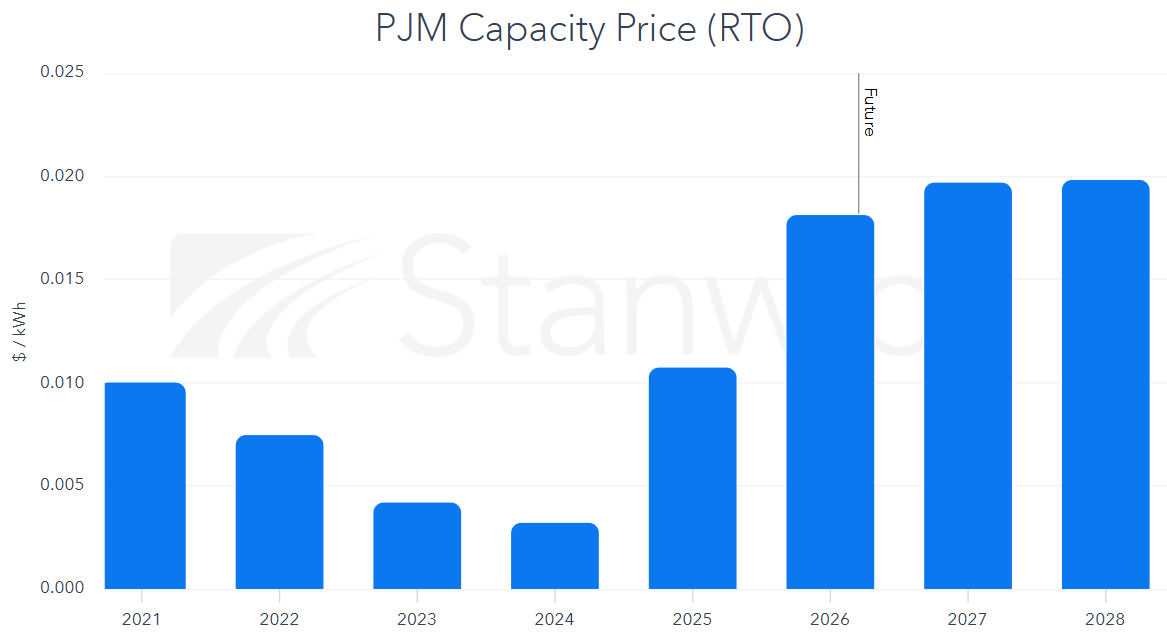
Prices shown in $/kWh assuming a 70% load factor
The PJM Capacity Price Collar
PJM implemented a temporary capacity price collar for the 2026/2027 and 2027/2028 auctions to help limit extreme volatility while broader market issues are addressed. In practice, the collar proved highly meaningful, as both auctions ultimately cleared at the cap. That outcome underscores how tight the PJM capacity market has become and suggests that, absent the collar, prices likely would have settled materially higher.
Looking ahead, the market does not yet have the same level of certainty for the next round of auctions. PJM has proposed extending the collar framework to the 2028/2029 and 2029/2030 delivery years, and while many market participants expect some form of collar to remain in place, the final parameters are not yet settled. If approved, the collar could be wider or otherwise adjusted, which is an important consideration when suppliers are pricing capacity for years that have not yet cleared. This uncertainty matters for businesses entering multi-year electricity contracts today, particularly when future capacity assumptions can materially affect the all-in rate and the risk of later adjustments.
Where Capacity Pricing Can Become Confusing for Buyers
When suppliers offer fixed-price electricity contracts that extend into future planning years where the capacity auction has not yet cleared, they must estimate what those capacity costs will be. These estimates can vary significantly depending on the assumptions used.
In almost all cases, suppliers use actual auction results for the planning years that have already been cleared, since those capacity costs are known. For later years, where auction results are not yet available, they must rely on assumptions that can vary widely. In some cases, suppliers may use relatively low estimates for those unknown periods, which can make the overall price of a multi-year contract appear more attractive on paper.
That can become problematic because many supply agreements include provisions allowing the supplier to adjust the price later if the actual capacity auction clears above the assumed value used in the original pricing. If the market ultimately clears closer to the upper end of the expected range, the customer may see those additional costs passed through after the contract has already been signed.
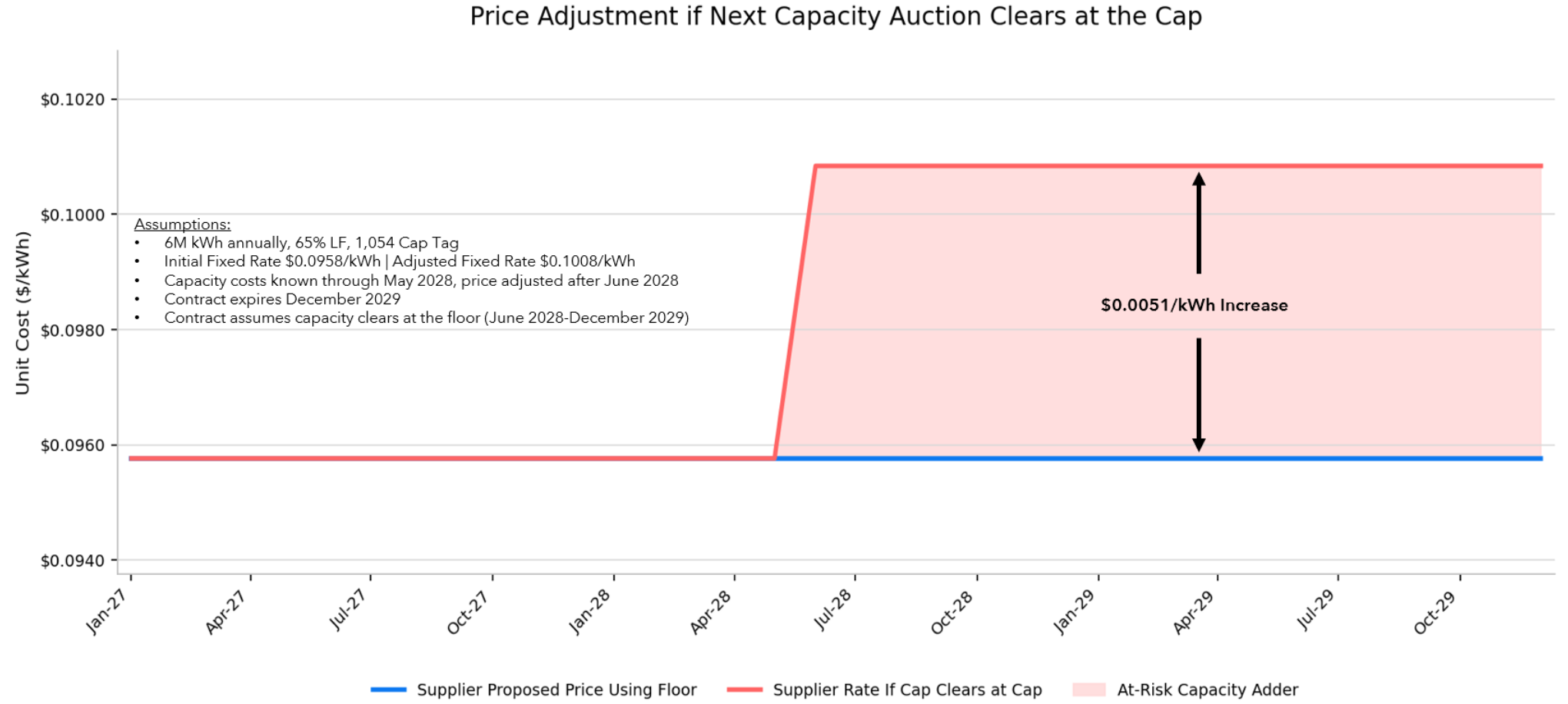
For energy buyers who are unaware of how these assumptions are embedded in supplier pricing, a contract that initially appears competitive may carry more risk than it seems. As shown in the image above, a proposed fixed rate of $0.0958/kWh could ultimately rise to an effective rate of $0.1008/kWh once the supplier adjusts for the actual capacity cost in the previously unknown period.
Why Transparency Matters in Energy Procurement
Not all energy advisors approach procurement in the same way. In competitive markets, some advisors focus primarily on securing the lowest advertised rate, while others prioritize helping clients understand the underlying assumptions and potential risks embedded within supplier offers.
At Stanwich Energy, our approach is rooted in transparency. Our goal is not simply to secure a contract, but to ensure that our clients understand how the price is constructed and what factors could influence their costs over the life of the agreement. That includes analyzing capacity assumptions, identifying contractual provisions that allow for future cost adjustments, and modeling how different auction outcomes could affect the total energy spend.
In a market environment where capacity costs are volatile and regulatory frameworks are still evolving, this level of transparency has become increasingly important.
What Businesses Should Look For in an Energy Advisor
As PJM capacity markets continue to evolve, energy buyers should expect more than simple price comparisons from their advisors. A strong advisor should be able to explain how capacity costs are being incorporated into supplier pricing, identify areas where assumptions are being made for future auctions, and help clients evaluate the potential range of outcomes before committing to a long-term contract.
Energy procurement should not be solely about selecting the lowest number on a spreadsheet. It should be about understanding the structure of the offer and ensuring that the contract aligns with a company’s risk tolerance and financial planning.
The PJM capacity market is undergoing significant structural change, and those changes are beginning to ripple through the retail electricity market. Temporary mechanisms like the price collar may help stabilize prices in the near term, but uncertainty remains around how future auctions will clear and how regulatory frameworks may evolve.
For businesses purchasing electricity, the most important takeaway is simple: understanding how capacity costs are treated within a contract is just as important as the price itself.
At Stanwich Energy, we believe clients deserve clarity before they sign an energy agreement. By taking a proactive and transparent approach to procurement, businesses can avoid unexpected surprises and make energy decisions with greater confidence in an increasingly complex market.
About Stanwich Energy
Stanwich Energy is a trusted, independent energy advisory firm dedicated to helping organizations across the United States buy and manage energy more strategically. We provide energy procurement, sustainability solutions, risk management, reporting, and ongoing market intelligence supported by deep industry expertise and proprietary technology. Our client-first approach helps businesses reduce costs, optimize energy usage, and confidently navigate the complexities of today’s energy markets.
Ready to talk energy strategy? Share a few details on our Contact Us page and we’ll reach out to schedule a quick call.