



There are not many moments in energy markets when sustainability and affordability align this clearly, but this is one of them. Renewable Energy Credits, or RECs, are currently trading at very low levels, giving end users an opportunity to make progress on ESG and decarbonization goals without taking on significant cost. For companies that have wanted to increase renewable participation but hesitated because of price, the current market presents an attractive opening.
What a REC Represents
A REC represents the environmental attributes associated with one megawatt-hour of renewable electricity generation. When a wind or solar project produces electricity, both the power itself and the renewable attribute are created. The REC is the instrument that captures that environmental value.
For end users, that matters because RECs provide a credible way to support renewable generation and address Scope 2 emissions, even if the physical electricity delivered to a facility still comes from the broader grid. In practice, RECs remain one of the simplest tools available for organizations that want to improve the sustainability profile of their electricity use without changing the way they physically buy power.
Why Prices Are So Low
It is important to separate voluntary RECs from compliance RECs because they serve different markets and behave differently on price.
Compliance RECs are used to meet state Renewable Portfolio Standard requirements. Because that demand is driven by regulation, pricing is usually firmer and often materially higher.
Voluntary RECs, including Green-e products, operate differently. These are typically purchased by companies pursuing ESG targets, sustainability commitments, or cleaner energy offerings. Because they are not required by law, demand depends on corporate buying interest. Right now, that market is well supplied, and prices have fallen sharply.
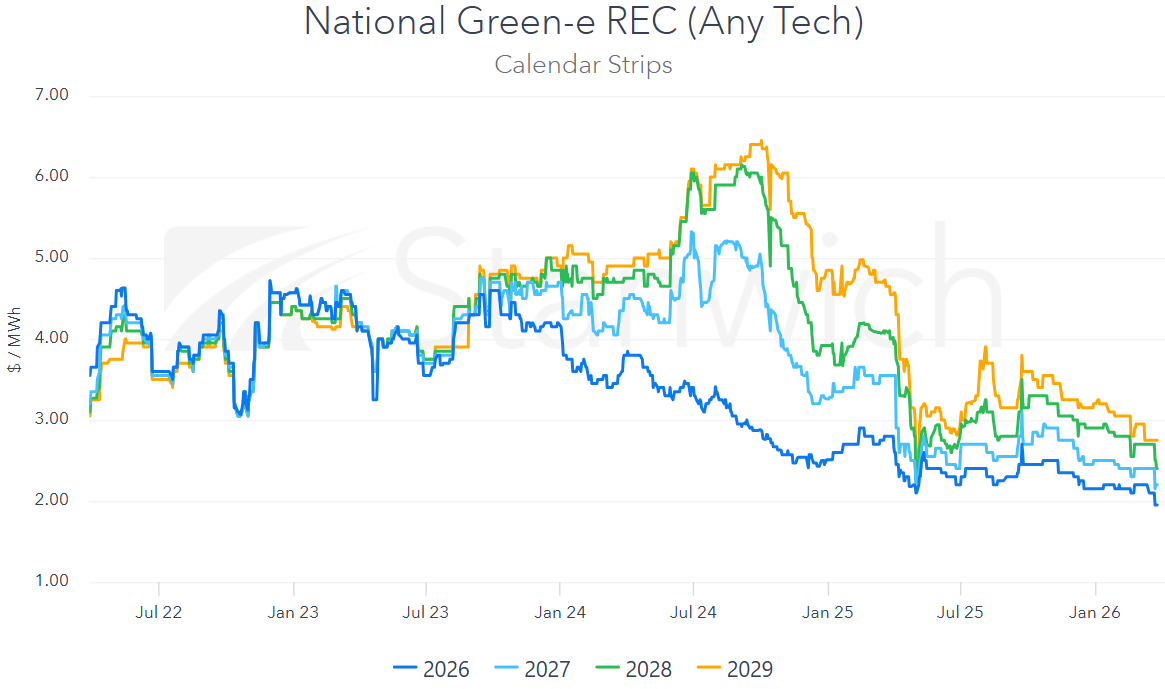
That weakness appears to be largely the result of supply outpacing demand. Over the last several years, renewable generation has continued to expand, bringing more RECs into the market. At the same time, voluntary buying activity has not grown quickly enough to absorb that supply.
Recent tax policy changes may also influence where the market goes next. With the One, Big, Beautiful Bill changing the outlook for certain clean energy incentives, developers may face greater pressure to move projects forward while key credits remain available or before eligibility becomes more restrictive. That could help keep supply available in the near term. Over time, however, if those policy changes slow future project development, REC markets could tighten and prices may rise from today’s levels.
What This Means for End Users
For end users, this creates a practical and relatively low-cost entry point. Companies can improve the sustainability profile of their electricity use, support ESG reporting, and advance internal decarbonization goals at a lower cost than in prior years.
The value is not only in price, but also in simplicity. RECs can be layered into an existing procurement strategy with minimal disruption, and they offer a clear and understandable way to demonstrate action. In a market where many organizations are being asked to do more with tighter budgets, that combination matters.
How RECs Can Be Purchased
There are generally two straightforward ways to buy RECs.
The first is through the electricity supply contract, where a customer elects to green a portion of its usage. This is usually the easiest option because it is simple to administer and works within the existing supply structure.
The second is through a standalone REC purchase, where the renewable attributes are procured separately from the physical electricity contract. This can offer more flexibility and control, but it may require some reconciliation at the end of the reporting period to match actual usage.
Both approaches can work well. The right fit depends on whether the customer values simplicity or prefers more direct control over timing and structure.
Why This Market Deserves Attention
RECs are often treated as a secondary part of the energy conversation, but current pricing makes them worth a closer look. Voluntary REC prices are unusually low, implementation is relatively simple, and the cost to act is modest.
That window may not stay open indefinitely. Over time, supply and demand will rebalance, and pricing may become less favorable. For now, though, the market is offering end users a rare chance to capture renewable value at a very manageable cost.
About Stanwich Energy
Stanwich Energy is a trusted, independent energy advisory firm dedicated to helping organizations across the United States buy and manage energy more strategically. We provide energy procurement, sustainability solutions, risk management, reporting, and ongoing market intelligence supported by deep industry expertise and proprietary technology. Our client-first approach helps businesses reduce costs, optimize energy usage, and confidently navigate the complexities of today’s energy markets.
Ready to talk energy strategy? Share a few details on our Contact Us page and we’ll reach out to schedule a quick call.